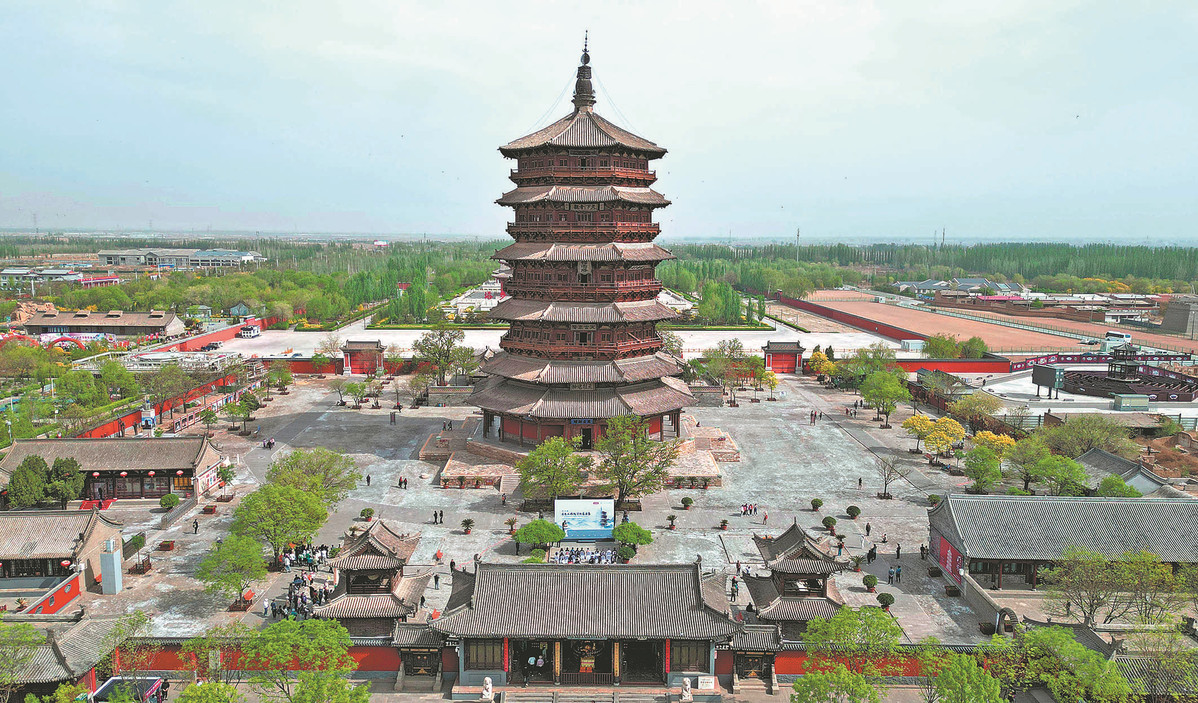
Fogong Temple
Overview
Fogong Temple, located in Yingxian county of Shanxi province, is renowned for housing the Sakyamuni Pagoda, also known as the Yingxian Wooden Pagoda. This architectural masterpiece is the tallest and oldest surviving pure wooden pagoda in the world, constructed entirely without nails. Built during the Liao Dynasty (916-1125) in 1056, it stands as a testament to ancient Chinese ingenuity and craftsmanship. The pagoda has withstood numerous natural disasters and historical events over nearly a millennium, showcasing the durability and resilience of traditional construction techniques.
Historical Significance
The Sakyamuni Pagoda, reaching a height of 67 meters, is an octagonal structure comprised of nine stories, with five visible from the exterior and four concealed within. This structure embodies the architectural style of a wooden-framed pavilion, a skillful synthesis of form and function. Its design features intricate mortise and tenon joints, which contribute to its stability and robustness. Each story of the pagoda houses Buddhist statues and murals from the Liao Dynasty, reflecting the profound religious significance and cultural artistry of its time.
Renowned architect Liang Sicheng visited the pagoda in 1933, where he meticulously measured and documented its structure. His work was instrumental in highlighting the pagoda's architectural and cultural value, introducing it to both national and international audiences. Over the years, the pagoda has developed a slight lean, prompting urgent calls for restoration to preserve this historical landmark for future generations.
Architectural and Religious Value
Fogong Temple's pagoda is not only an architectural marvel but also a symbol of religious devotion. It is believed to have been constructed by Lu Ban, the legendary master carpenter of ancient China, and is revered by locals for its spiritual significance. The pagoda's design reflects the aspirations of Buddhist architecture, aiming to embody spiritual principles through its physical form. The careful balance of aesthetics, function, and symbolism in the pagoda's construction makes it a significant site for Buddhists and historians alike.
The interior of the pagoda is adorned with detailed paintings and statues, depicting various aspects of Buddhist cosmology and teachings. These artistic elements serve as a visual narrative of the Buddhist faith and provide insights into the spiritual life of ancient China. The pagoda's construction without the use of nails is a reflection of Buddhist philosophy, emphasizing harmony with nature and the interdependence of all things.
Technological Preservation Efforts
In recent years, advanced technologies have been employed to aid in the preservation and restoration of the pagoda. Artificial intelligence (AI) has played a critical role in safeguarding this ancient monument, offering insights into its structural integrity and historical transformations.
The use of VR technology provides an immersive experience for visitors, enabling them to explore the pagoda's interior virtually. This innovative approach not only enhances tourist engagement but also helps in preserving the physical structure by limiting direct human interaction. Through the integration of AI and big data, researchers are able to gather extensive information about the pagoda's original design, material degradation and potential future changes.
Restoration Challenges and Future Directions
Restoration efforts for the Sakyamuni Pagoda are driven by the need to address its current lean and ensure its longevity. The process involves meticulous preparation and a deep understanding of the pagoda's historical context and structural dynamics. Experts emphasize the importance of unraveling the pagoda's past transformations to guide effective conservation strategies.
The pagoda's slight tilt is viewed as an indication of its "sickness", necessitating immediate action to "cure" it. This involves finding a metaphorical "hospital" to facilitate its restoration, utilizing a combination of traditional craftsmanship and modern technology. The goal is to maintain the pagoda's structural integrity while preserving its historical and cultural essence. Article reference1. AI used to help preserve China's oldest wooden pagoda. chinaservicesinfo.com. 2024Photo Gallery(4 pictures)CategoriesCultural HeritageTagHistorical BuildingCultural LandscapeRelatedWooden Pagoda in Yingxian, ShanxiCatalogue1. Overview2. Historical Significance3. Architectural and Religious Value4. Technological Preservation Efforts5. Restoration Challenges and Future Directions- - - []








